One Resume for Every Role? Why That’s Quietly Costing You Interview Calls
Learn less. Read job descriptions first. Tune each resume. One-size-fits-all is for socks, not job applications.

KaabilAI team
· 2 min read
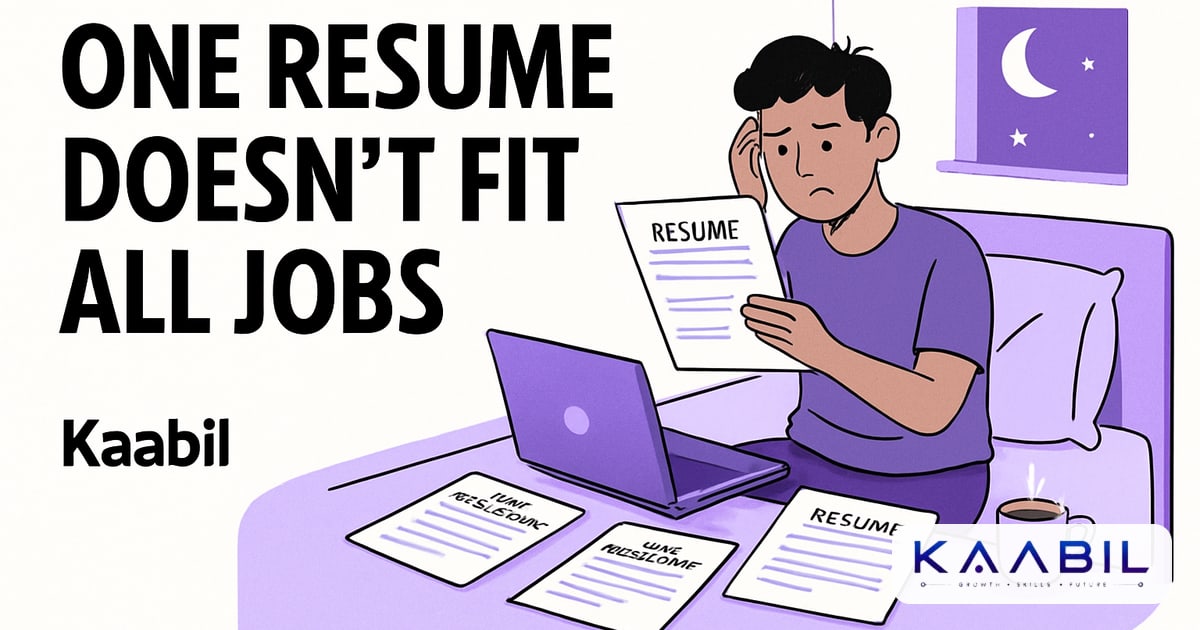
You apply to twelve jobs in one night.
You upload the same resume each time.
No changes. No edits. Download, attach, send, repeat.
In your head, it makes sense.
“I’m the same person. My experience didn’t change in the last ten minutes.”
So why should your resume?
But after days of “Thank you for applying” and nothing else, you start thinking…
“Why am I not hearing back?”
Here’s what we’ve seen again and again:
One resume for every role seems efficient.
But it quietly costs you calls, replies, even that first test assignment.
It’s like wearing the same shirt to every occasion, interview, shaadi, cricket game, pooja.
Fits somewhere. But most places, you just look out of place.
Every job description is a clue.
Read it line by line.
They’re not just telling you what they want.
They’re telling you what they will check for.
And if your resume doesn’t mention it?
The recruiter won’t assume you have it.
They’ll just move to the next file.
Most people don’t bother.
They see “good communication”, “Excel”, “teamwork”, and think, “I have all of this.”
But your resume only says “worked on projects, helped with fest”.
It doesn’t say “led a team”, “analysed data”, “coordinated schedules”.
The problem isn’t your ability.
The problem is making your abilities visible, each time, in the way that job needs.
Let’s be real.
Half the time, you don’t even read the whole JD before sending your file.
You just hope something matches.
But here’s what changes when you slow down and actually read it:
You see what’s missing.
You spot the skills they want.
You find places in your own work, even small ones, where you did those things.
You rewrite a line or two.
You swap “helped with planning” to “planned event schedule using Excel for 200+ participants” because the job needs it.
Now, your resume is not just a list.
It’s proof you can do their work.
It’s not about lying.
It’s about showing them the parts of you that fit their puzzle.
All the rest can stay on standby, for another job, another day.
Will you get a call every time? No.
But your chances go up each time you choose to match what they’re actually asking.
Not what you hope they spot.
Next time, before you hit apply, just pause for five minutes.
Read the job description, end to end.
Ask, “What are they really looking for?”
See if your resume shows it.
If not, add a line, move a project, swap an example.
Don’t wait for luck to do the work.
Learn less. Read job descriptions first. Tune each resume.
One-size-fits-all is for socks, not job applications.
That’s why Kaabil shows you what skills a job asks for that your resume doesn’t show yet, and helps you fill the real gaps.
And if you’re still stuck, mail us at hello@kaabilai.com, we’ll try to help you make your resume fit the jobs you actually want.