Listing Every Tool You’ve Heard Of? That’s Not Helping Your Resume
Don’t just list every tool you found on Google. Show what you can really do, not just what you touched once. That’s how your skills section works for you, not against you.

KaabilAI team
· 2 min read

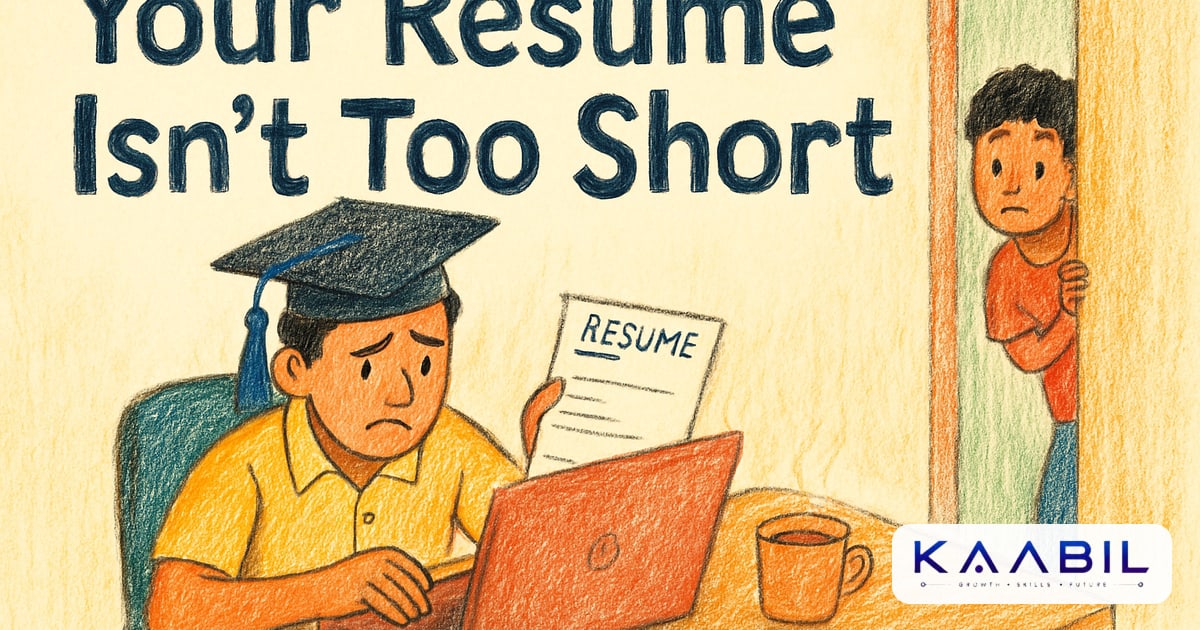
It’s 1 AM and your resume is open again.
The skills section is staring at you, empty.
You start typing.
Excel. Python. Canva. SQL. Tableau. Figma.
You add every tool you can remember from college, YouTube, one project, one Udemy course, even something your friend mentioned once.
In your head:
“If I list more tools, I’ll look smarter.”
“Everyone is adding these, so maybe I should too.”
You scroll LinkedIn for inspiration.
And suddenly, you have a skills list longer than your actual CV.
Here’s the part nobody tells you.
Writing ‘Python’ on your resume doesn’t mean you’re a Python expert.
It means you’re ready if they actually ask you to use it.
And that’s where most people get stuck.
Because knowing the name of a tool isn’t a skill.
Clicking through a tutorial isn’t the same as finishing something real with it.
Recruiters know this.
Your skills section isn’t a grocery list of every app you’ve opened.
It’s supposed to be a snapshot of what you can actually do.
You add ‘Excel’.
But if someone asks you to make a pivot table or automate something, can you?
Or is it just there because everyone else wrote it?
There’s nothing wrong with learning new tools.
But when you list everything you’ve ever touched or heard of, you’re not showing range.
You’re showing confusion.
A long skills list with no real proof invites one question:
“Can you show me how you’ve used this?”
Real talk:
If you’ve used Canva for your college fest, great. Write it.
But don’t add Photoshop because your friend used it on your laptop once.
If you played with SQL but never built a table, think twice before tossing it in.
Say what you can do, not what you googled.
Nobody expects a fresher to know everything.
But what you do add, you should be ready to answer.
If someone grilled you in an interview:
“Tell me about a time you built something with this tool?”
Would you have a story?
You don’t have to keep up with every new tool on the internet.
Pick the 2–3 you can actually do something with.
Describe how you’ve used them.
That’s what builds trust.
So next time you’re tempted to pad that skills section, breathe.
Ask yourself:
If you had to show this skill tomorrow, could you actually do it?
If you’d be confident, it belongs on your resume.
If you’d freeze, let it go.
Real skills beat big lists every time.
Show less, show honestly, show what you can do.
Learn less. Learn for depth. Apply it somewhere.
That’s why Kaabil helps you spot the skills your resume really shows, and helps you fill the gaps with the right courses, so you spend your energy where it counts.
And if you’re still lost in the skill jungle, mail us at hello@kaabilai.com.
We’ll try to help you make your skills section actually work for you.